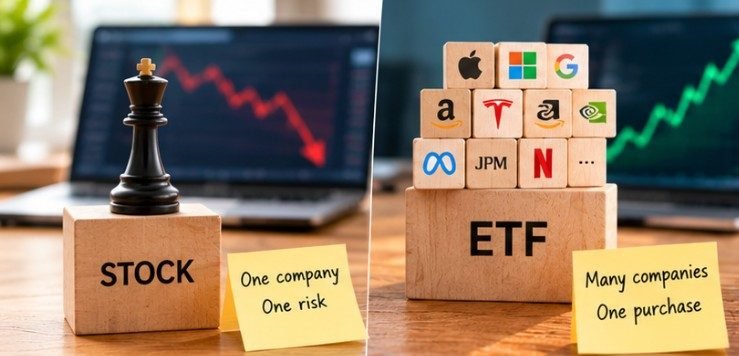
One bad stock pick can damage a small portfolio far more than most first-time investors expect. A broad ETF, by contrast, can spread one purchase across dozens, hundreds, or even thousands of holdings. That difference is at the heart of ETFs vs stocks for beginners: both can build wealth, but they concentrate risk very differently.
For a new investor, the better first question is not “Which can make me richer faster?” It is “How much company-specific risk am I prepared to carry while I am still learning?”
What You Actually Own
A stock represents ownership in one company. Your return depends heavily on what happens to that business—its profits, products, management, competition, debt, and valuation. Investor.gov explains that stockholders own part of a company and may benefit through price appreciation or dividends.
An exchange-traded fund pools money from investors and owns a portfolio of assets. Many ETFs hold shares of numerous companies, although others focus on bonds, industries, investment strategies, commodities, or even a single stock.
Like an individual stock, an ETF normally trades on an exchange throughout the trading day.
Here is the detail beginners should not miss: “ETF” does not automatically mean “diversified.” Investor.gov notes that some funds are narrowly focused, so a broad-market ETF may spread risk widely while a sector or single-stock ETF can remain highly concentrated.
The Biggest Difference Is Concentration Risk
Imagine you have $5,000 to invest.
Put all of it into one company and a 40% decline leaves you with $3,000. From that lower starting point, the stock must rise roughly 67% just to return to $5,000.
Put the same amount into a broadly diversified ETF and one company’s collapse may have a much smaller effect because the fund owns many other businesses. Diversification cannot stop losses when the entire market declines, but it can reduce the damage caused by one company.
FINRA describes diversification as an important way to manage concentration risk and specifically notes that new investors may want to consider stock funds rather than relying entirely on individual stock selection.
ETFs vs Stocks for Beginners: Side-by-Side
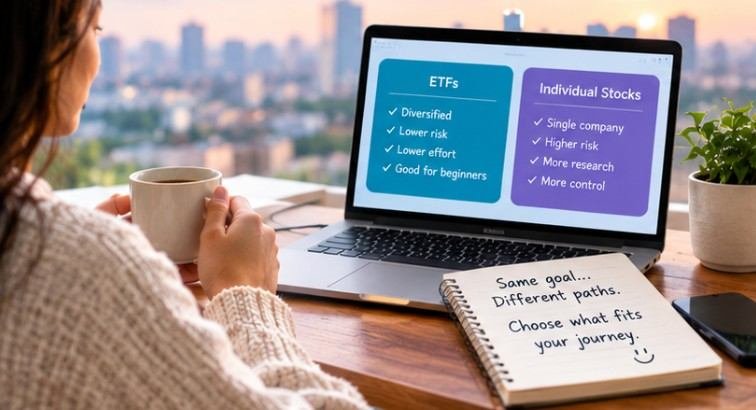
| Factor | Broad ETFs | Individual Stocks |
| Diversification | Often high | Low unless you own many companies |
| Research required | Moderate | High |
| Ongoing fund fee | Usually an expense ratio | No fund expense ratio |
| Company-specific risk | Usually lower | Higher |
| Control over holdings | Limited | Full control |
| Upside from one winner | Spread across portfolio | Fully captured |
| Trading | Intraday | Intraday |
| Common role | Portfolio core | Selective positions |
The word “broad” matters. Leveraged, inverse, thematic, sector, and single-stock ETFs may behave very differently from diversified index funds.
Why ETFs Often Make the Easier Starting Point
Beginners usually face two constraints at the same time: limited capital and limited investing experience.
Building a diversified portfolio through individual stocks can require choosing companies across multiple sectors and then following earnings, financial statements, competitive threats, management decisions, and valuation changes.
A diversified ETF compresses much of that portfolio construction into one security. That does not guarantee positive returns. Stock ETFs can still fall significantly during bear markets.
What the ETF structure can do is make diversification easier.
It may also make investor behavior simpler. Instead of responding to every earnings announcement or executive change, long-term investors can concentrate on regular contributions, asset allocation, and their financial goals.
ETFs Still Have Costs
Commission-free trading does not mean investing is free.
ETFs generally charge an annual expense ratio, which is deducted from fund assets. The SEC explains that fund expenses can reduce investment returns over time, even when the percentages initially appear small.
Individual stocks do not carry a fund expense ratio, but frequent trading can still generate transaction-related costs and potentially taxable gains.
Before choosing an ETF, I would check its expense ratio, benchmark or strategy, largest holdings, sector concentration, bid-ask spread, and whether several companies dominate the portfolio.
Where Individual Stocks Can Make Sense
Buying individual companies is not automatically a bad beginner strategy.
Stocks can make sense for investors who enjoy business analysis and accept a wider range of possible outcomes. Ideally, you should be able to explain how the company makes money, understand its financial position, identify major competitors, and describe what could cause your investment thesis to fail.
The mistake is confusing familiarity with research.
Using a company’s smartphone, drinking its beverages, or seeing its stores everywhere does not automatically mean its shares are attractively priced.
Some investors therefore use a “core-and-satellite” structure. Diversified funds form most of the portfolio, while a smaller portion is reserved for individual companies.
A portfolio with 90% diversified funds and 10% individual stocks is one illustration—not a rule or recommendation. The appropriate allocation depends on your goals, investing horizon, financial position, and tolerance for volatility.
A Five-Question Test Before You Buy
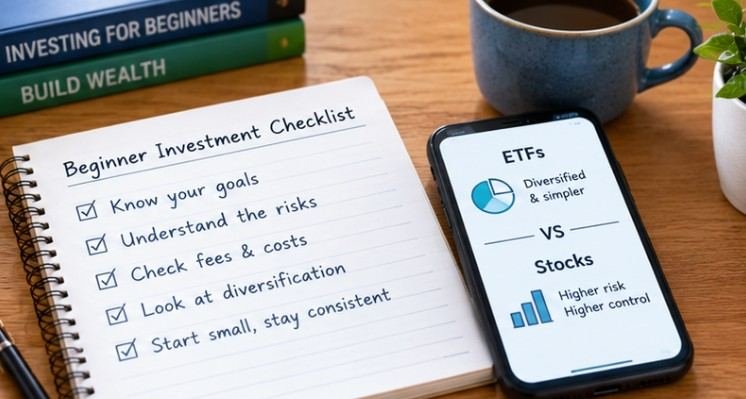
1. What is my time horizon?
Money you expect to need soon generally should not depend heavily on volatile stocks or stock ETFs. A longer horizon gives investors more time to recover from major market declines.
2. Can I explain what I own?
For an ETF, understand its strategy, holdings, concentration, and fees. For a stock, understand the company’s business, financial condition, competition, and risks.
3. What happens if it falls 40%?
If a 40% decline would cause you to panic-sell or derail an important financial goal, the position may be too large or too risky.
4. Am I actually diversified?
Owning five technology companies is not the same as owning a diversified portfolio. Neither is holding several ETFs that contain many of the same large companies.
5. What are the tax consequences?
Selling stocks or ETFs for a gain in a taxable U.S. brokerage account can create capital-gains taxes. The IRS generally classifies a gain as long term when an investment was held for more than one year and short term when held for one year or less.
Tax-advantaged accounts such as traditional and Roth IRAs operate under different rules.
One Protection Beginners Often Misunderstand
SIPC protection is not insurance against market losses. Also adapt for money habits that build wealth.
If a SIPC-member brokerage firm fails and customer assets are missing, SIPC protection can cover eligible securities and cash up to $500,000, including a $250,000 limit for cash held for securities transactions. It does not reimburse you because an ETF or stock simply falls in price.
That distinction matters. Diversification helps manage investment risk; SIPC addresses certain problems involving failed brokerage firms.
Frequently Asked Questions
1. Are ETFs better than stocks for beginners?
Broad, low-cost ETFs are often simpler because they can provide diversification through one purchase. Stocks may suit beginners prepared to research companies and accept greater company-specific risk.
2. Can I lose all my money in an ETF?
It is possible, particularly with highly concentrated or specialized products. A broadly diversified ETF is generally less dependent on the success or survival of one company.
3. Do ETFs pay dividends?
Many stock ETFs distribute dividends received from their underlying companies. The amount and payment schedule depend on the fund and the securities it owns.
4. How many ETFs does a beginner need?
There is no required number. One broad ETF may already own hundreds or thousands of securities. Focus on diversification, fund strategy, and portfolio overlap rather than collecting more funds.
The Better First Move Is Usually the Simpler One
The central lesson behind ETFs vs stocks for beginners is that investing skill is not measured by how many companies you can successfully pick. It is measured by whether your portfolio matches your goals, time horizon, risk tolerance, and ability to remain invested.
For many beginners, a broad, low-cost ETF provides a cleaner foundation because the outcome depends less on one company. Individual stocks can still play a useful role as knowledge grows. Start with investments you understand, keep concentrated positions sensible, and remember the opening lesson: avoiding one disastrous mistake can be more important than discovering one spectacular winner.