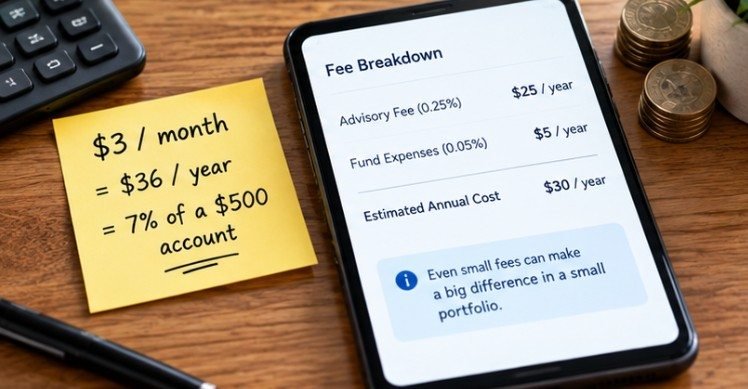
A $3 monthly investing fee sounds almost trivial. On a $500 account, however, that works out to $36 a year—more than 7% of the account balance before investment expenses or market performance enter the picture. The SEC uses essentially this example to warn investors that seemingly cheap automated advice can become expensive for small portfolios.
That detail captures why robo advisors explained properly requires more than saying that algorithms invest your money. These services can make diversified investing remarkably simple, but investors still need to understand what the software chooses, what it costs, and what it cannot know about their lives.
What Is a Robo-Advisor, Exactly?
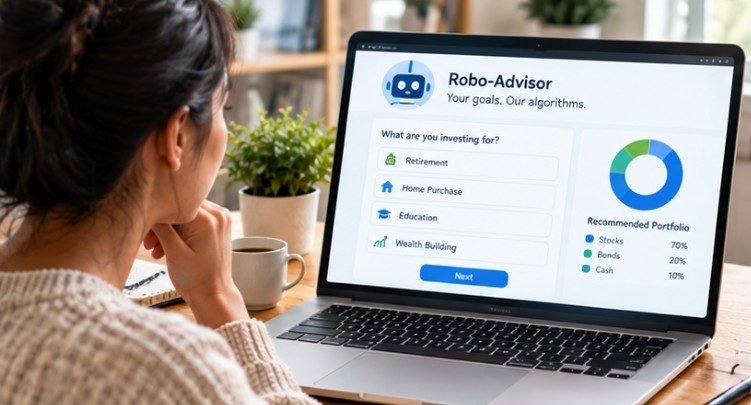
A robo-advisor is a digital investment advisory service that uses software to recommend and usually manage a portfolio. Instead of beginning with a long conversation with a financial adviser, you typically answer questions about your goal, investing timeline, income, financial position, and tolerance for losses.
The algorithm then maps those answers to an investment strategy.
The SEC’s investor guidance on robo-advisers explains that these platforms frequently create and manage portfolios from information collected through online questionnaires. Many portfolios use broad exchange-traded funds, although strategies differ considerably between providers.
A robo-advisor is therefore not a stock-picking robot trying to predict tomorrow’s winners. Most are closer to automated portfolio managers.
What Happens After You Open an Account?
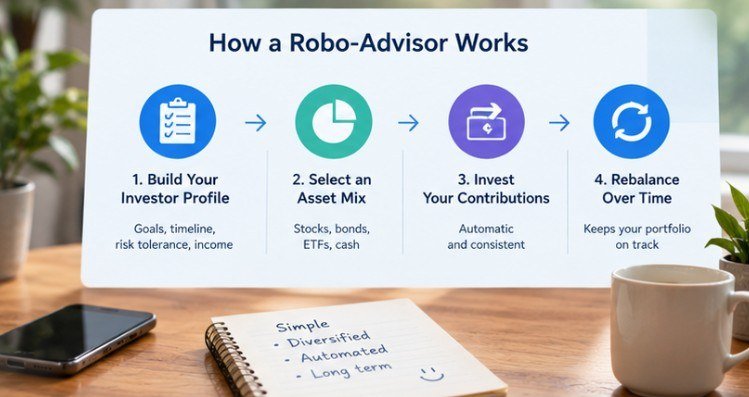
The process usually follows four stages.
1. The Platform Builds Your Investor Profile
You might be asked whether you are investing for retirement, a home purchase, education, or general wealth building. Questions about your time horizon and willingness to accept market declines help determine how aggressive the proposed portfolio should be.
This input matters enormously. FINRA notes that automated advisory services depend on information supplied by investors, and some tools collect more detailed information than others.
2. An Asset Mix Is Selected
A growth-focused portfolio might hold a larger share of stock ETFs, while a more conservative allocation may include more bonds or cash-like investments.
This is asset allocation: deciding how much of a portfolio belongs in different investment categories. Diversification then spreads money among numerous securities rather than relying heavily on a handful of companies.
3. New Contributions Are Invested
Once the portfolio is established, deposits can generally be allocated automatically. That removes one behavioral obstacle many beginners face: repeatedly deciding what to buy.
Automation can be especially useful for someone who wants to invest consistently without monitoring financial markets every day.
4. The Portfolio Is Rebalanced
Suppose your target portfolio begins at 70% stocks and 30% bonds. Strong stock returns could eventually push stocks to 78%.
Rebalancing moves the portfolio closer to the intended allocation. This matters because without adjustment, investment risk can gradually become very different from the risk level you originally selected.
Robo-Advisor vs DIY Investing vs Human Advice
| Approach | Main Strength | Main Limitation | Often Suits |
| Robo-advisor | Automated portfolio management | Limited personalization | Hands-off investors |
| DIY investing | Maximum control and potentially low costs | Requires knowledge and discipline | Confident self-directed investors |
| Human adviser | Deeper financial planning | Usually more expensive | Complex financial situations |
The important point is that one option is not automatically superior.
A simple investor with one retirement goal may gain little from paying for extensive personal planning. Someone dealing with business ownership, estate planning, concentrated stock positions, unusual tax circumstances, or retirement-income decisions may benefit considerably from human expertise.
The Fee Number Beginners Often Miss
Most people compare robo-advisors by looking at the headline advisory fee. That can hide part of the real cost.
Consider a hypothetical $10,000 account with a 0.25% advisory charge. The advisory fee would equal approximately $25 annually. If the underlying funds averaged another 0.05% in expenses, that would add about $5.
Your approximate combined annual cost would therefore be $30, excluding other possible expenses.
Subscription pricing requires even more attention.
The SEC warns that flat monthly charges can represent a surprisingly high percentage of a small account. Its investor bulletin gives the example of a $3 monthly charge on $500: $36 annually, or more than 7% of the starting balance.
Before signing up, calculate:
Annual subscription cost ÷ account balance × 100
That converts a flat fee into a percentage you can compare more easily with percentage-based advisory pricing.
Tax-Loss Harvesting Sounds Better Than It Always Is
Tax-loss harvesting is frequently marketed as a sophisticated robo-advisor feature.
The strategy involves selling an investment that has declined, potentially using the realized loss to offset certain taxable gains, and replacing the investment while maintaining the intended portfolio strategy.
But automated harvesting is not free tax money.
The IRS has wash-sale rules that can prevent a loss from being immediately deductible when substantially identical securities are acquired within the applicable period around the sale. Investors with multiple brokerage accounts or IRAs should be particularly careful because activity outside the robo-advisor’s view may affect the tax result.
The IRS Publication 550 guidance on wash sales explains these rules in detail. For many investors, tax-loss harvesting is useful only in taxable accounts and only when their personal tax situation makes the harvested losses valuable.
The Biggest Weakness: The Algorithm Only Knows What You Tell It
One misconception behind robo advisors explained poorly is the idea that automation creates fully personalized financial advice.
It often does not.
An algorithm might know that you are 35, want to retire at 65, and describe yourself as comfortable with risk. It may not know that your income has suddenly dropped, you carry expensive credit-card debt, your spouse holds similar investments elsewhere, or you expect to buy a home next year unless you provide that information.
NASAA’s investor advisory on robo-advisers similarly cautions that algorithms differ and may produce different portfolio recommendations even for comparable investor profiles.
Automation removes work. It does not remove responsibility.
A Five-Minute Test Before Choosing One
Before opening an account, answer these five questions.
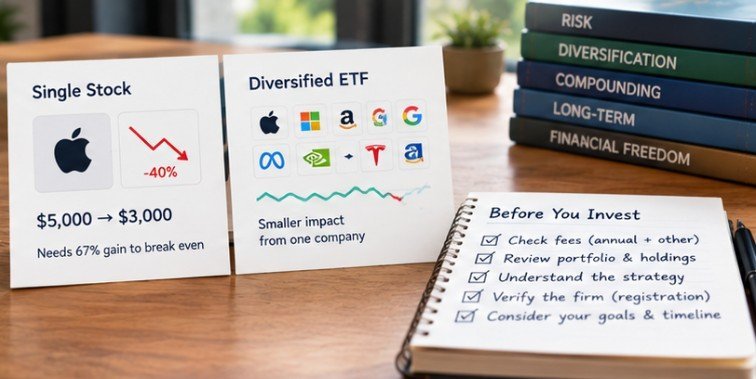
- What is this money for? A retirement account with a 30-year horizon is very different from money needed for a home down payment in three years.
- What is my total annual cost? Include advisory charges, subscription fees, fund expense ratios, transfer charges, and other costs.
- What investments will I actually own? Look beyond words such as “balanced” or “growth.”
- Can I speak to a qualified person when circumstances change? Some services are fully automated; others use hybrid models.
- Is the adviser properly registered? Review regulatory disclosures, services, fees, conflicts, and disciplinary history before transferring money.
Do not overlook custody either. SIPC explains that qualifying customers at SIPC-member brokerages may receive protection if the brokerage firm fails, generally up to $500,000 including a $250,000 limit for protected cash. SIPC does not insure you against market losses. Read how SIPC protection works.
Who Is a Robo-Advisor Best For?
Robo-advisors can make sense for beginners who want diversified investing without selecting and rebalancing funds themselves.
They may also suit experienced investors who deliberately want a simple, rules-based portfolio rather than frequent trading.
A robo-advisor becomes less compelling when financial decisions require information that does not fit neatly into a questionnaire. Business owners, investors with complex taxes, families coordinating several financial goals, and people approaching major retirement decisions may need more individualized planning.
Frequently Asked Questions
1. Are robo-advisors safe?
They are investment services, so portfolios can lose value. Check the adviser’s registration, brokerage arrangement, security practices, investment strategy, and applicable SIPC protection before investing.
2. Can a robo-advisor beat the stock market?
Usually that is not its main purpose. Most focus on diversified asset allocation, disciplined investing, rebalancing, and sometimes tax management rather than consistently outperforming market benchmarks.
3. How much money do I need to start?
Minimums vary by provider. Some accept relatively small balances, but beginners should examine percentage and subscription fees carefully because fixed monthly charges can be costly on small accounts.
4. Are robo-advisors good for retirement?
They can be useful for long-term retirement investing, particularly for investors wanting automatic diversification and rebalancing. More complex retirement-income, tax, Social Security, and estate decisions may require professional advice.
The Real Value of Putting Investing on Autopilot
The appeal of automation is not that an algorithm knows where markets are heading. It doesn’t. The real advantage is that software can repeatedly perform boring but important jobs—investing deposits, maintaining diversification, and rebalancing—without fear or excitement interfering.
That $3 fee example from the opening also shows why convenience should never replace scrutiny. Before choosing a platform, understand its portfolio, convert every fee into a meaningful annual cost, verify the firm, and decide whether an algorithm has enough information to serve your actual goal. A good robo-advisor simplifies investing; it should never make you stop paying attention.