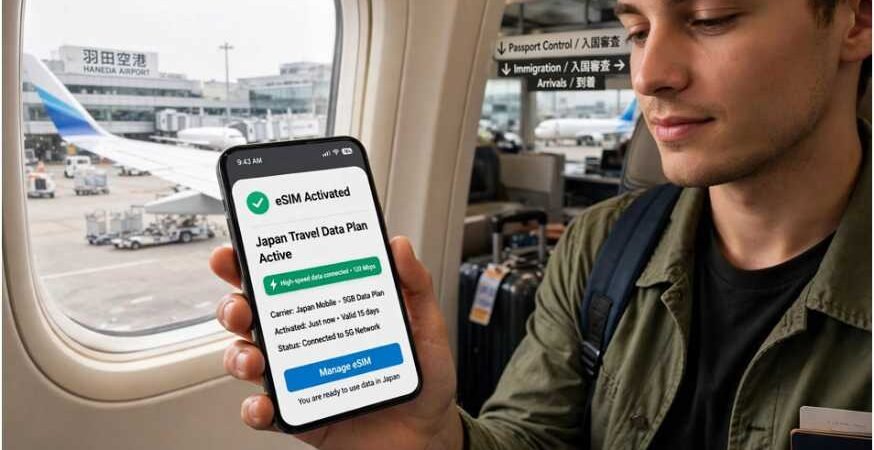
I used to spend my first hour in every foreign terminal hunting down a cellular kiosk with a paperclip in my wallet. Today, landing in Tokyo or London means tapping one toggle in my settings and having high-speed data before reaching passport control.
Evaluating an eSIM vs physical SIM for international travel comes down to convenience versus raw connectivity control. Both connect to identical cell towers, but how they handle data routing, line separation, and hardware restrictions determines which option will save your sanity on the road.
How Both SIM Types Work Abroad
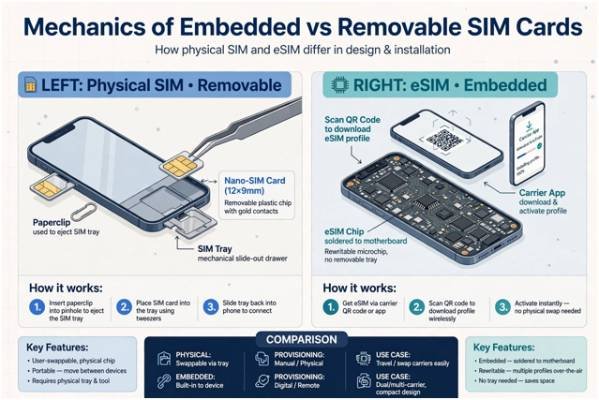
Whether digital or plastic, a SIM (Subscriber Identity Module) carries cryptographic keys that authenticate your device with a cellular network. The user experience differs sharply once you leave your home provider’s borders.
The Mechanics of Embedded vs Removable SIM Cards
A physical SIM is a removable plastic chip that slots into a mechanical tray on your device. When you buy a physical prepaid card abroad, you purchase network access directly from a local carrier.
An eSIM (embedded SIM) is a tiny, rewritable microchip soldered directly onto your device motherboard during manufacturing, governed by standard specifications from the GSMA Technical Consortium. Instead of swapping pieces of plastic, you install an encrypted digital profile over Wi-Fi by scanning a QR code or downloading it inside a travel provider’s app. Modern smartphones can store dozens of eSIM profiles simultaneously, letting you alternate between them through your phone software.
What Happens to Signal Strength and Network Bands?
A common myth is that eSIMs receive weaker signals than plastic cards. Neither format impacts your reception. Signal strength depends entirely on:
- The modem and internal antenna architecture of your phone.
- The specific LTE and 5G frequency bands supported by your hardware.
- The roaming agreements established between your provider and the local infrastructure operators.
If a local carrier operates on Band 20 or Band 28, both an eSIM and a physical SIM bound to that network will register the exact same decibel-milliwatts (dBm) signal strength.
Head-to-Head Comparison: eSIM vs Physical SIM
This practical comparison shows how both technologies perform across essential travel criteria:
| Travel Factor | Travel eSIM (Digital Profile) | Local Physical SIM (Plastic Chip) |
| Setup Speed | Instant; install at home via QR code, activates upon arrival | 20–45 mins; locate airport shop, queue, swap trays |
| Multi-Country Routing | Seamless; regional packages cover 30–140 countries automatically | Manual; requires buying new chips at each border crossing |
| Local Phone Number | Rare; 90% are data-only VoIP lines | Included; provides native local voice minutes and SMS |
| Hardware Compatibility | Modern, carrier-unlocked flagship smartphones only | Universal; works in almost any phone with a SIM tray |
| Theft Resistance | High; digital profiles cannot be physically pulled or cloned | Moderate; stolen phones can have their SIM chips extracted |
| Cost Per Gigabyte | Slightly higher on small allocations ($2–$5/GB) | Lowest per GB on high-data domestic prepaid bundles |
The Latency Trade-Off: What Provider Testing Reveals
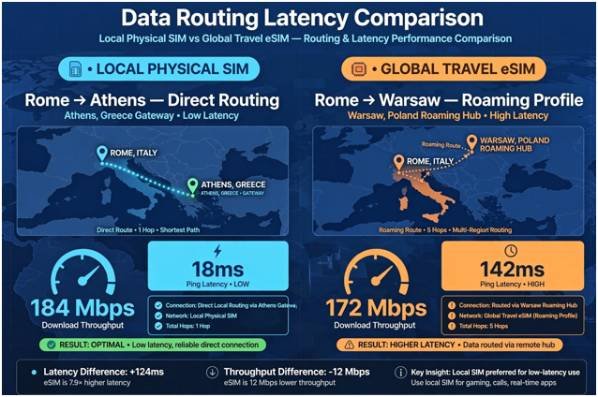
Most comparisons skip how global eSIM providers route data traffic. When you buy a physical prepaid card from a local shop in Rome, your data routes directly through an Italian telecom gateway.
Travel eSIM aggregators, however, often rely on international roaming broker networks. During field testing in Athens, I noticed a dramatic ping disparity between a local physical SIM and an international travel eSIM:
| Connection Metric | Local Physical SIM (Cosmote) | Global Travel eSIM (Roaming Profile) |
| APN Gateway Location | Athens, Greece (Direct) | Warsaw, Poland (Roaming Hub) |
| Download Speed | 184 Mbps | 172 Mbps |
| Upload Speed | 38 Mbps | 31 Mbps |
| Round-Trip Ping (Latency) | 18 ms | 142 ms |
While download speeds remain competitive, high ping creates a noticeable delay when loading map pins, opening travel apps, or loading security tools. If you use diagnostic utilities to how to tell if a browser extension is safe or run cloud audits while working remotely abroad, that latency creates drag. Direct routing remains a distinct advantage of native physical SIMs.
Dual-SIM Setups and Protecting Your Home Line
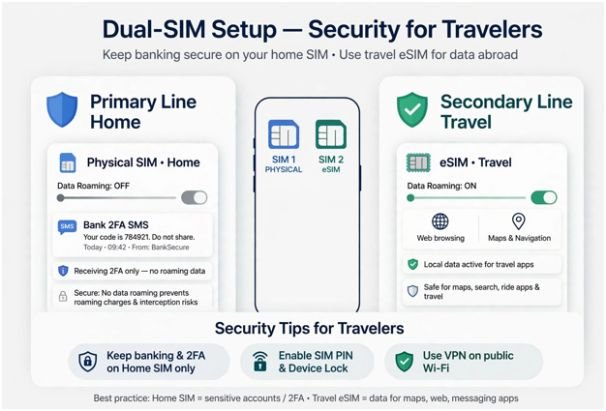
The strongest case for traveling with an eSIM is dual-SIM standby. If you use a physical card at home, you can leave it in your tray, turn off its data roaming, and assign your travel eSIM as the primary cellular data source.
[Your Phone]
├── Primary Line (Home Physical SIM): Data Roaming OFF -> Receives Bank 2FA SMS
└── Secondary Line (Travel eSIM): Data Roaming ON -> Handles All Web & Maps
This arrangement allows you to receive incoming bank verification texts without paying international roaming fees. It also closes a major security vulnerability. When you remove your domestic SIM at an airport counter, that plastic chip contains sensitive line identity keys. Misplacing it or having a phone stolen allows bad actors to place the chip into another handset and intercept password reset codes.
Connecting to unknown regional Wi-Fi to configure connections also carries risks. Before connecting to unprotected transit hubs, check which apps are tracking you and ensure background location sharing is disabled.
Decision Matrix: Which Option Fits Your Trip?
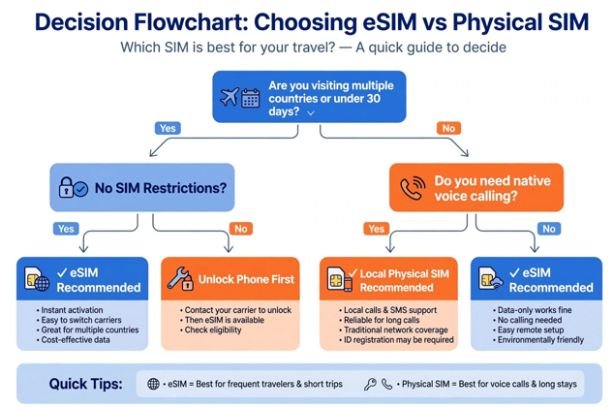
Before buying either, verify that your device has no active carrier lease blocks. The Federal Communications Commission (FCC) unlocking guidelines require US domestic carriers to unlock paid-off phones upon request, but this process requires up to 48 hours to clear.
Are you visiting multiple countries or under 30 days?
├── YES -> Does your phone show “No SIM Restrictions”?
│ ├── YES -> Choose an eSIM (Instant multi-country setup)
│ └── NO -> Unlock phone via carrier; fallback to pocket Wi-Fi
└── NO -> Do you need native voice calling for local reservations?
├── YES -> Buy a Local Physical SIM at your destination
└── NO -> Choose an eSIM for simplicity and security
For travelers on iOS hardware, review the Apple international eSIM configuration instructions to confirm how your specific model assigns data switching abroad.
Frequently Asked Questions About International Travel SIMs
1. Can I keep my WhatsApp number active when using an international travel eSIM?
Yes, WhatsApp prompts you to keep your existing phone number when detecting a new data connection.
2. Will an international eSIM work if my smartphone is carrier-locked?
No, a carrier-locked smartphone blocks all third-party eSIM profiles until your home network unlocks the device.
3. Do travel eSIMs consume more battery power than traditional physical SIM cards?
No, battery consumption is identical because the power draw comes from your cellular antenna searching for signals, not the SIM format.
4. Can an eSIM run out of data without warning me?
Most travel eSIM companion apps track your data balance in real time and send push notifications when reaching 20% capacity.
The Final Verdict: Ditch the Paperclips, Keep the Plan
If you own an unlocked smartphone made after 2020 and plan an ordinary vacation across one or more borders, choose an eSIM. You eliminate airport queues, protect your domestic phone number for banking logins, and avoid losing a microchip under an airplane seat.
Reserve physical SIM cards for extended multi-month stays, remote off-grid destinations where global agreements fall flat, or situations where you must make standard voice calls to landlines. Before you head to the gate, run your provider’s unlock check, load your profile over your home Wi-Fi, and hit the ground connected.