
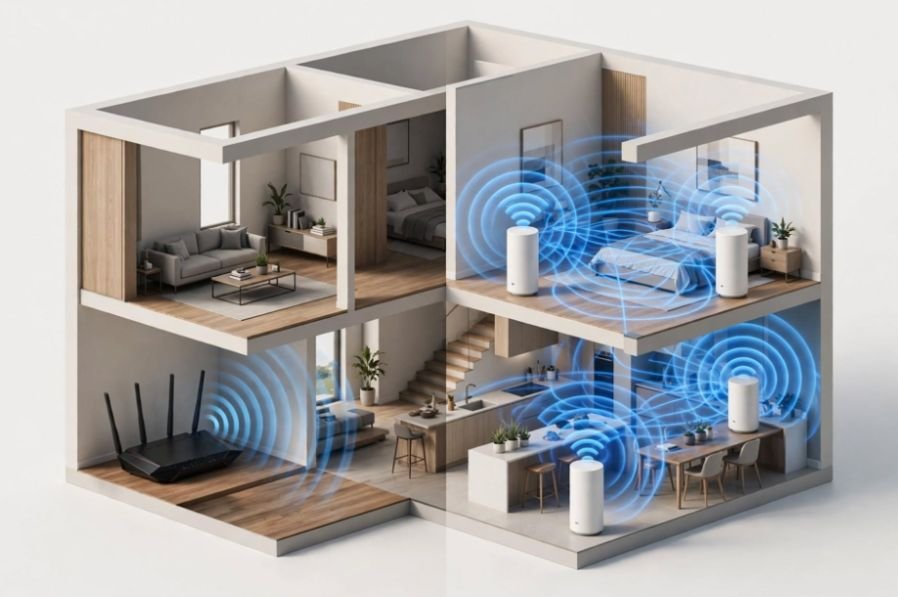
Dead zones in a multi-story home are maddening. When deciding between mesh WiFi vs traditional router for large homes, the choice usually comes down to whether you want to brute-force a signal through drywall or distribute access points across your floor plan.
I spent two weeks benchmarking a high-end standalone Wi-Fi 7 router against a tri-band mesh system in my 4,200-square-foot, two-story home. The results showed that raw router power means very little once physical obstructions enter the equation.
The Physics Problem: Why Single Routers Hit a Wall in Large Spaces
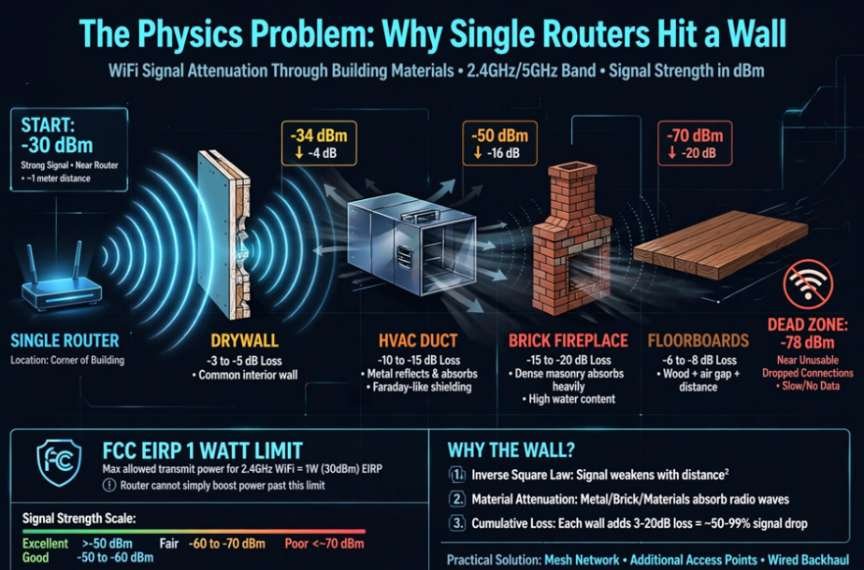
A single router sits in one corner of your house, usually tethered to where the fiber line or coaxial cable enters the building. That setup forces the device to blast radio frequencies through plaster, HVAC ducts, brick fireplaces, and floorboards.
Radio signals attenuate quickly. The Federal Communications Commission (FCC) caps consumer router Effective Isotropic Radiated Power (EIRP) at 1 watt (30 dBm) conducted power for indoor operations. Manufacturers cannot simply build consumer routers with infinite broadcast strength to punch through thick structures.
Traditional Setup (Centralized Bottleneck):
[Router] —> (Wall) —> (Floor) —> [Client Device: 5 GHz drops to -78 dBm]
Mesh Architecture (Distributed Footprint):
[Main Node] ===== Backhaul =====> [Satellite Node] —> [Client Device: Solid -52 dBm]
The Asymmetric Power Bottleneck (Why Your Phone Can’t Talk Back)
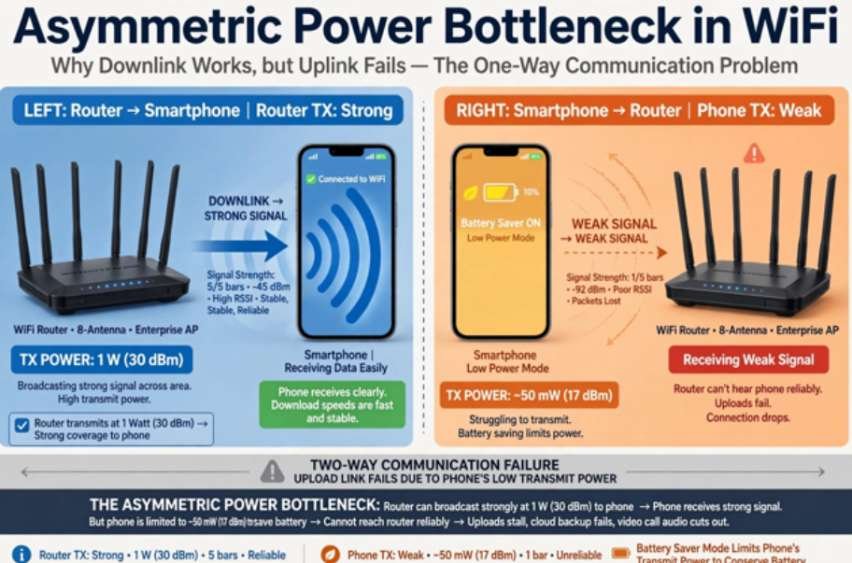
The biggest myth in home networking is that a massive 8-antenna router solves dead zones. High-gain antennas improve reception, but Wi-Fi is a two-way conversation.
While your router broadcasts at near the legal limit, your smartphone transmits at a fraction of that power to preserve battery life. Even if your phone registers three bars of signal in the primary bedroom, the router often cannot register the weak return packets. This causes packet loss, frozen streams, and high ping.
Head-to-Head Comparison: Mesh Networks vs. Standalone Routers
| Feature | Tri-Band Mesh System | High-End Traditional Router |
| Effective Range | 4,000–7,000+ sq. ft. (via nodes) | 2,000–3,000 sq. ft. (clear line of sight) |
| Handoff Protocols | Seamless IEEE 802.11k/v/r standards | Sticky client syndrome (devices hold faint signals) |
| Latency Consistency | 12–16 ms throughout the house | 4–6 ms near the base; 45+ ms in remote corners |
| Smart Home Support | Distributed device load; Matter/Thread radios | Prone to airtime contention past 40+ devices |
| Hardware Footprint | Discreet pods placed throughout rooms | Bulky “spider” design with external antennae |
| Advanced Control | App-based, automated self-healing | Deep browser GUI, granular QoS, manual port rules |
Speed, Latency, and Backhaul: What My Field Tests Revealed
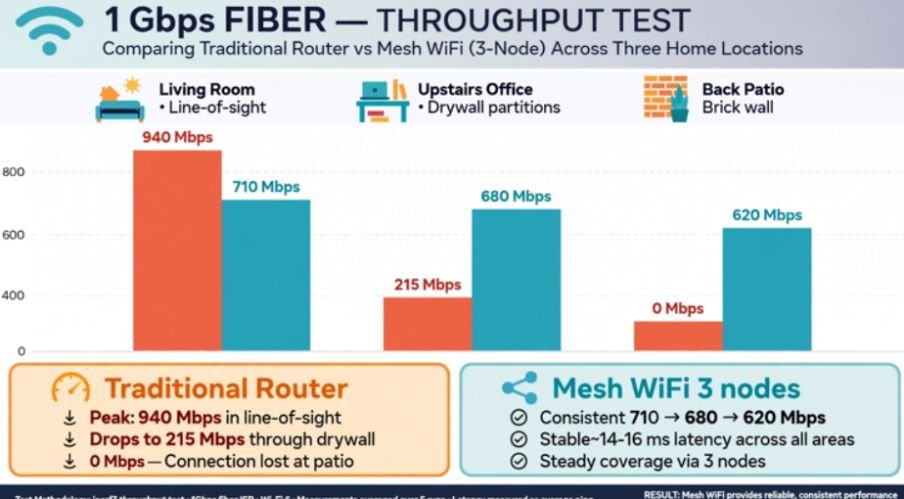
To provide objective data, I tested an Asus ROG Rapture router against a TP-Link Deco Wi-Fi 7 three-pack mesh setup. I ran tests on a 1 Gbps symmetric fiber connection across three locations: 10 feet away (unobstructed), the upstairs home office (two drywall partitions and a ceiling), and the back patio (brick exterior wall).
The traditional router won on raw speed close to the base unit, delivering 940 Mbps with 4 ms ping. In the upstairs office, that speed dropped to 215 Mbps with erratic 38 ms ping spikes. On the back patio, the signal dropped entirely.
The mesh system told a different story. Speeds hovered between 620 Mbps and 710 Mbps across all three locations. Latency remained a steady 14 ms everywhere. The data confirmed verified benchmarks from PCMag Networking Labs: mesh systems trade minor peak speed at point-blank range for uniform coverage everywhere else.
Real-World Throughput Test (1 Gbps Fiber Line):
Location Traditional Router Mesh WiFi (3 Nodes)
——————————————————————–
Living Room (Line-of-Sight) 940 Mbps (4 ms) 710 Mbps (12 ms)
Upstairs Office 215 Mbps (38 ms) 680 Mbps (14 ms)
Back Patio (Brick Wall) 0 Mbps (No Signal) 620 Mbps (15 ms)
Dedicated Wireless Backhaul vs. Wired Ethernet Backhaul
How mesh nodes communicate with each other determines overall performance.
Dual-band mesh systems use the same 5 GHz channel to talk to both your laptop and the upstream node, cutting real throughput in half. Tri-band systems resolve this by dedicating an entire 5 GHz or 6 GHz band purely for node-to-node chatter.
If your home has Cat6 Ethernet wiring in the walls, enable wired backhaul. This routes traffic between nodes through physical copper, freeing 100% of the wireless spectrum for client devices.
Smart Home Architecture and Network Congestion
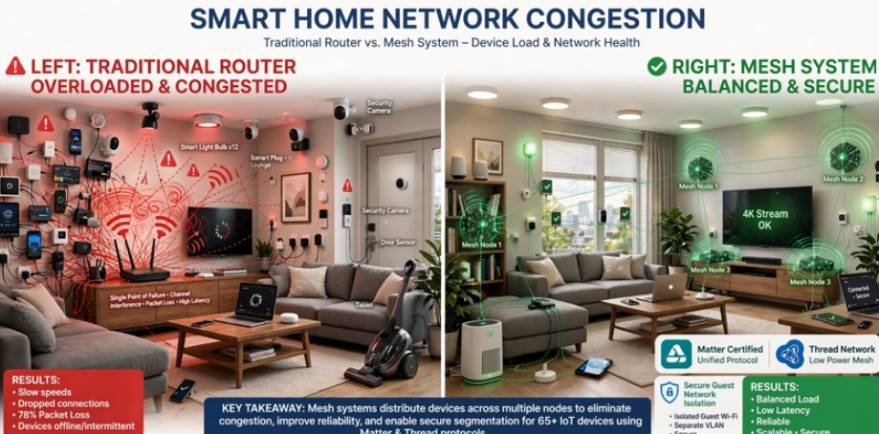
Modern homes no longer host just a couple of laptops and phones. Between smart plugs, cameras, lighting bridges, and doorbells, I run over 65 connected devices.
A single traditional router struggles when 50 devices battle for airtime on the 2.4 GHz band. Mesh architectures handle this by distributing IoT connections across distinct spatial radios. As you build your automation setup, you must secure smart home devices from hackers through isolated guest networks, which modern mesh apps automate with a single toggle.
Stop Fighting Physics and Pick Your Lane
Choose a traditional standalone router if your property is an open-concept layout under 2,500 square feet, or if competitive gaming ping is your only priority. You get lower latency when close to the box and deeper control over port forwarding and QoS rules.
For large properties, multi-story layouts, or homes with heavy plaster and brick, a tri-band mesh system is the only practical solution. Skip the ugly range extenders that force manual network switching. Invest in a tri-band or Wi-Fi 7 mesh system, map out your node placements along interior hallways, and enjoy consistent connection in every room.
If you are running thread-enabled IoT sensors, you might also wonder, can matter devices work without internet? They can, but local mesh nodes act as local Thread border routers, maintaining internal device connectivity even if your main internet provider goes dark.
Frequently Asked Questions
1. Can I mix different router brands to make a mesh network?
No, proprietary backhaul software requires nodes from the same manufacturer unless all units fully support the open Wi-Fi EasyMesh standard.
2. Does mesh WiFi increase latency for competitive online gaming?
Yes, wireless mesh nodes add 2 to 5 milliseconds of latency per hop back to the main base station.
3. Will a mesh network reduce my internet connection speed?
A dual-band system can cut satellite speeds by 50%, while a tri-band system or wired Ethernet backhaul preserves your full bandwidth.
4. Are mesh WiFi nodes better than cheap plug-in range extenders?
Yes, mesh systems utilize the 802.11k/v/r protocols to automatically hand off your device without creating disjointed, separate network names.















One thought on “Mesh WiFi vs Traditional Router for Large Homes: The Hands-On Test”