
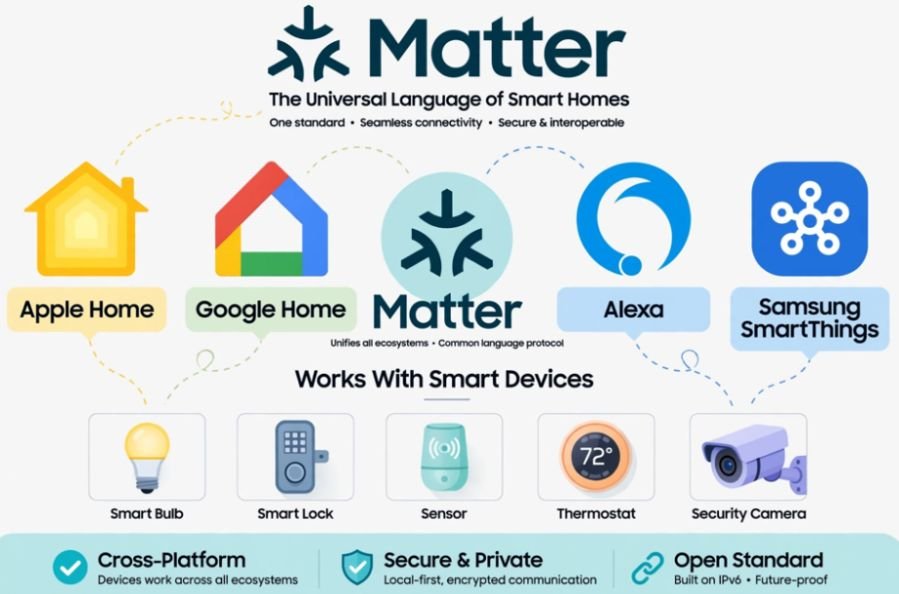
I spent last year rebuilding my home with Matter and Thread. I learned this fast: asking matter vs thread for smart home devices is like asking if you need English or a phone line. You need one to speak, one to travel. Matter is the language devices use to understand each other. Thread is the low-power road they use to move data.
If you buy smart gear in 2026, you will see both logos. Here is what they really do.
What Is Matter? My Take After Setting Up 30+ Devices
Matter is the universal application layer built by the Connectivity Standards Alliance. Apple, Google, Amazon, and Samsung all backed it. Before Matter, my Eve sensor only worked with Apple Home. My Nest Hub ignored it.
Matter fixed that fragmentation. Now my setup works across ecosystems at once.
How Matter Actually Works
Matter does not have its own radio. It rides on IP. That means it runs on top of networks you already have: Wi-Fi, Ethernet, or Thread. It defines device types, commands, and security so setup is consistent. You scan a QR code, your Matter controller like a HomePod mini, Nest Hub, or SmartThings Station commissions it, and it appears everywhere.
I run my Matter controllers through Apple Home and Google Home simultaneously. No duplicate apps. That is the point. You can read the official spec breakdown from the Connectivity Standards Alliance.
What Is Thread? Why My Battery Sensors Finally Last
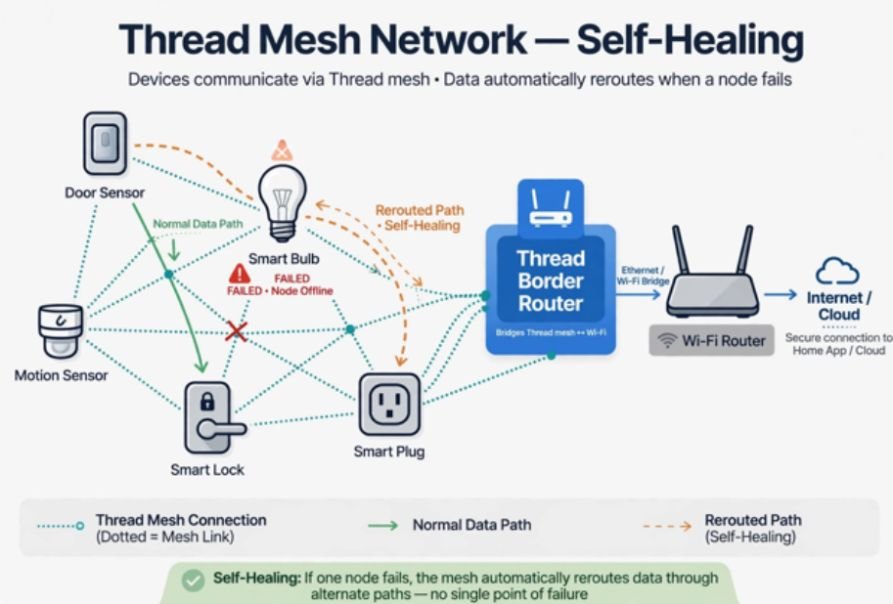
Thread is different. It is a low-power mesh networking protocol built on 802.15.4. It was made for tiny battery devices that cannot afford Wi-Fi.
Wi-Fi is power hungry and star topology. Every device talks directly to your router. Thread forms a self-healing mesh. My door sensor talks to my smart plug, which talks to my border router. If one device goes offline, data reroutes. Response feels instant because it stays local.
This matters for battery life. My Matter over Wi-Fi motion sensor died in 6 weeks. My Matter over Thread version is at 78% after 8 months.
How Thread Mesh Fixes Wi-Fi Clog
In my apartment I had 42 devices on Wi-Fi. Video calls lagged. Thread moved 18 of those off Wi-Fi. Latency dropped from 300ms to under 40ms for lights. Thread needs a Thread Border Router to bridge the mesh to your IP network. Apple explains which of its devices act as one in this support article. Good news: you probably already own one.
Learn the technical foundation directly from the Thread Group.
Matter vs Thread for Smart Home Devices – The Real Difference
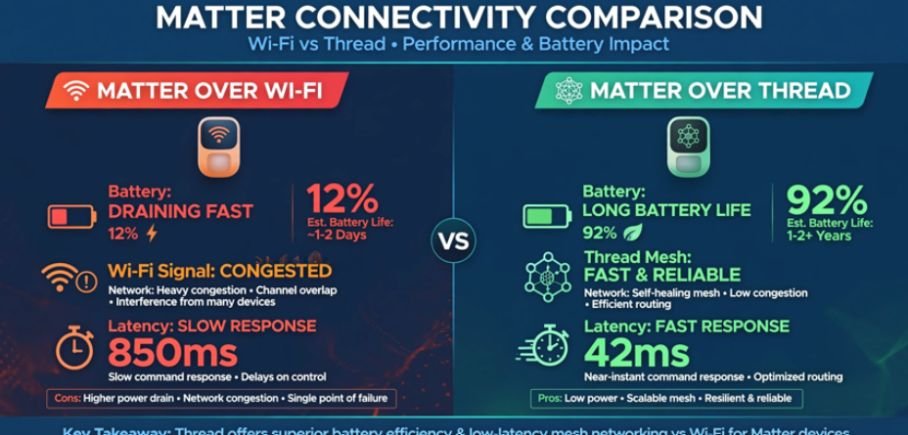
I track this as language vs road. Most blogs treat them as competitors. They are complementary layers of modern smart home technology.
| Feature | Matter | Thread |
| What it is | Universal application standard | Low-power mesh network protocol |
| Layer | Layer 3 Application Layer | Network / Transport + Radio Layer |
| Primary Goal | Interoperability across ecosystems | Reliability, low power, no Wi-Fi congestion |
| Runs On | Thread, Wi-Fi, Ethernet | Its own 802.15.4 mesh, bridged via Border Router |
| Hardware Required | Matter Controller | Thread Border Router |
| Best For | Every device type | Battery sensors, locks, buttons, plugs |
The Stack: How Matter Rides on Thread, Wi-Fi and Ethernet
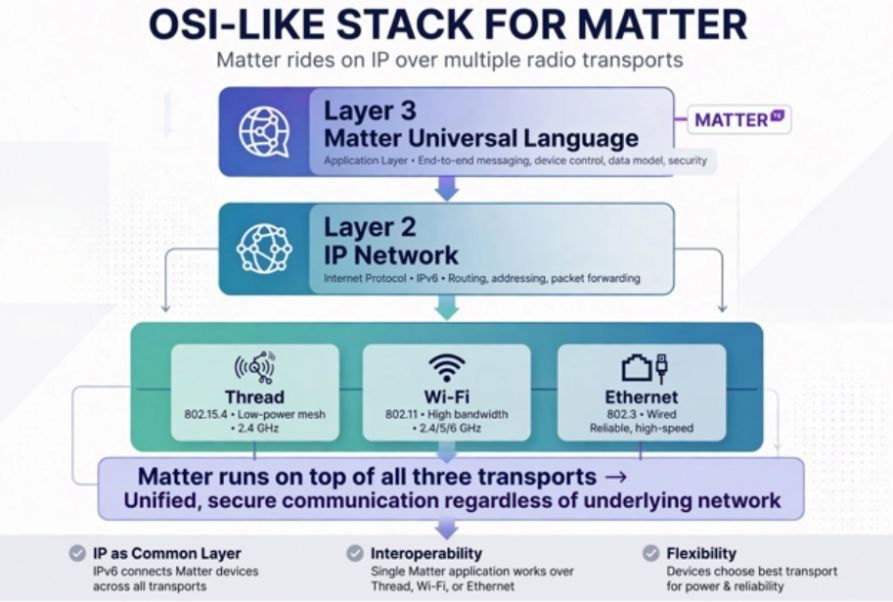
Think in three layers.
Layer 3 is Matter. It is the universal language. Layer 2 is IP networking. This is how data travels. Layer 1 is the physical radio: Thread radio, Wi-Fi radio, or Ethernet cable. Matter runs over IP, so it can use any of them. That is why you see Matter over Wi-Fi for cameras and Matter over Thread for sensors. Same language, different road.
My Test: Matter Over Thread vs Matter Over Wi-Fi
I ran two identical setups in my hallway: one Aqara motion sensor using Matter over Wi-Fi, one Eve motion using Matter over Thread. Same automations, same traffic.
The Thread sensor triggered lights in 0.3 seconds consistently. The Wi-Fi sensor varied from 0.6 to 1.8 seconds when my router was busy. After 60 days, Wi-Fi used 41% battery. Thread used 9%. For always-powered devices like my LG TV, Matter over Wi-Fi is perfect. For sensors, Thread wins by miles.
Do You Need Both? My Buying Rule
You do not need to choose. You need to match the device to the transport.
Buy Matter over Thread for anything battery powered or that needs instant local response: door/window sensors, motion sensors, smart locks, smart buttons, leak sensors. Battery lasts years, mesh stays stable.
Buy Matter over Wi-Fi or Ethernet for high-bandwidth plugged-in gear: TVs, speakers, cameras, robot vacuums, light strips. They need speed, not battery savings.
If a device says Matter over Thread, you still need both a Matter Controller and a Thread Border Router. Most modern hubs are both.
Frequently Asked Questions
1. Is Thread the same as Matter?
No. Thread is the low-power mesh network, Matter is the application language that can run on Thread.
2. Do I need a Thread border router for Matter?
Only if you buy Matter over Thread devices. Matter over Wi-Fi devices connect directly to your Wi-Fi router.
3. Can Matter work without Thread?
Yes. Matter works fine over Wi-Fi and Ethernet for plugged-in devices.
4. Which is better for battery devices?
Matter over Thread is better. It uses far less power and creates a reliable mesh.
Okay, So Stop Debating and Start Building Right
Matter vs Thread for smart home devices is not a fight. Matter solved the language problem. Thread solved the network problem. I stopped buying Wi-Fi sensors and my smart home finally stopped dropping. Start with one good border router and prioritize Matter over Thread for small sensors. Your Wi-Fi and your sanity will thank you.















3 thoughts on “Matter vs Thread for Smart Home Devices: Language vs Road Explained”